3rd Iranian Drone Strike Hits Radar Site in Bahrain
Tehran targeted U.S. military assets in the Gulf state three times this week, citing retaliatory measures for American operations in the region.
By Scott Marshall ·
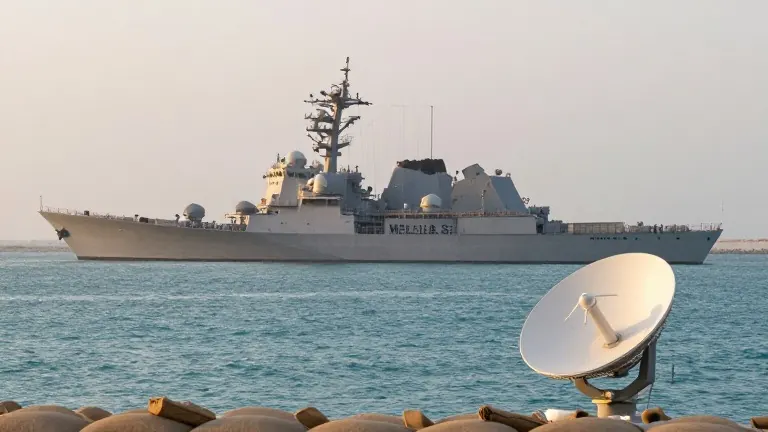
Bahrain, home to the U.S. Navy’s 5th Fleet, was struck by a third wave of Iranian drones on Tuesday morning. The projectiles targeted a U.S. radar facility on the island nation. Bahraini air defense systems intercepted the incoming fire, which officials described as "treacherous Iranian aerial attacks." The U.S. military reported no damage to American equipment and no injuries to U.S. personnel.
This latest incident caps a rapid escalation following a two-month pause in direct combat. Iran attacked a U.S. early warning radar facility in Bahrain on Friday. On Sunday, the country fired at a radar system located at an American helicopter base in the same kingdom. Although Tehran claimed success in these prior strikes, observers noted that little to no damage was evident.
The conflict, which began on Feb. 28 when the U.S. and Israel launched attacks on Iran, is now in its eighth month. President Donald Trump had initially promised the war would last only weeks. He has recently stated that new strikes are highly unlikely, yet he ordered a third aircraft carrier and thousands of additional troops to the Middle East. President Trump told Vice President JD Vance that talks were not needed at this time.
The arrival of the USS Theodore Roosevelt carrier strike group expanded the U.S. naval presence in the region. Combined U.S. naval assets in the Persian Gulf, Arabian Sea, Red Sea, and Mediterranean now exceed the force deployed at the start of the war. These assets include the USS George H.W. Bush and the USS George Washington aircraft carriers, along with smaller Navy ships maintaining the blockade of Iranian shipping. U.S. Central Command did not comment on whether all three carrier strike groups will remain in the area.
A U.S.-enforced naval blockade in the Strait of Hormuz has pressured Iran’s economy by restricting the flow of its crude oil to global markets. The strait, a critical waterway for world energy supplies, has seen shipping disruptions since the war began. Oil tankers moving through the strait under U.S. military protection have helped return Gulf oil shipments to roughly prewar levels. Iranian officials characterize the current situation as "no war, no peace." Mahdi Mohammadi, an adviser to Iran’s parliamentary chief, posted on social media on Monday that leaders view U.S. economic pressure as an effort to create a domestic "security crisis."
Iran’s Revolutionary Guard Corps stated that continued U.S. aggression against Iranian airspace and the use of regional bases for hostile acts would not go unanswered. The attacks followed U.S. strikes on Iranian communications towers and ongoing drone surveillance operations. Tehran-based security analyst Mostafa Najafi told The Associated Press that the strikes signal a shift in strategy, moving from waiting to retaliate to targeting operational capabilities. Hamidreza Azizi, a senior Iran analyst at the International Crisis Group, wrote on X that the risk of renewed war now depends on whether Tehran concludes the costs of restraint exceed the risks of escalation.
Regional leaders condemned the latest attack on Bahrain. Egypt, Qatar, Saudi Arabia, and the United Arab Emirates each called the strikes a violation of Bahrain’s sovereignty and a threat to regional stability. Qatar’s Foreign Ministry spokesman Majed Al Ansari warned at a news briefing in Doha that any escalation posed an "extremely grave danger" to diplomatic prospects. Negotiations to end the war have stagnated despite intensified mediation efforts from Qatar.
Shipping lanes remain volatile. The United Kingdom Maritime Trade Operations reported on Tuesday that a tanker was attacked twice north of Oman, with the second strike causing a fire on board. A cargo vessel off the coast of Yemen also repelled an attempt by armed men in a skiff to board it. Iran’s Fars news agency reported that two ships were struck by mines in the Strait of Hormuz and caught fire. It was not immediately clear if one of these incidents matched the report from British military operations.
In Yemen, Iran-backed Houthi rebels solidified control of the Bab el-Mandeb Strait, a critical route connecting the Gulf of Aden to the Red Sea. A group allied with the Saudi-backed Yemeni government retreated over the weekend, marking a setback for the anti-Houthi coalition. Sascha Bruchmann, a Bahrain-based defense analyst with the International Institute for Strategic Studies, noted that while shooting at ships causes fear, it is not yet enough to change the strategic equation. He told the AP that Tehran knows it needs to do something more, but the current strikes against Bahrain are not yet that move.
More World · Albuquerque news · Report a business · Got a Story?