BepiColombo Reaches Orbit Around Mercury After Eight-Year Journey
The joint European and Japanese mission completed a six-billion-mile flight to study the sun's closest planet, where surface temperatures exceed 800 degrees Fahrenheit.
By Paula Delgado ·
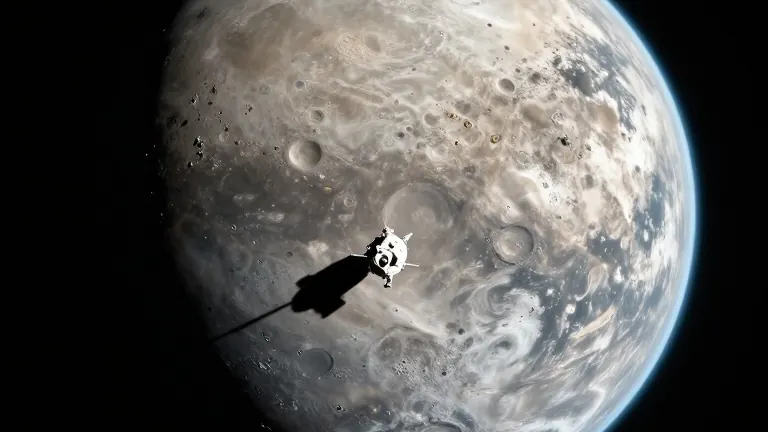
The BepiColombo spacecraft has traveled more than 6 billion miles to reach its destination. On Saturday, the pair of linked robotic explorers slipped into orbit around Mercury. This marks the first time a spacecraft has visited the planet in over a decade. The mission cost 2 billion dollars to execute.
Flight controllers in Germany confirmed the arrival after several hours of monitoring data. The spacecraft are 94 million miles away from Earth, making real-time communication difficult. A series of thruster firings slowed the craft enough for Mercury’s weak gravity to capture it. The European Space Agency announced the achievement via social media. Teams in Germany analyzed the streaming data before confirming the orbit.
The mission involves two separate probes that will detach from each other next month. One spacecraft is operated by the European Space Agency, and the other is a smaller craft from the Japan Aerospace Exploration Agency. Once separated, they will study Mercury from different altitudes. This allows scientists to compare measurements taken at the same time. Lead project scientist Geraint Jones said the team is eager for the new data to begin streaming down in the spring.
Mercury is the closest planet to the sun and is barely larger than the moon. It is one of the least explored bodies in the solar system. Only Uranus and Neptune have had fewer visitors. NASA’s Mariner 10 flew past Mercury three times in the mid-1970s. That team included the late Italian mathematician Giuseppe Colombo, for whom this mission is named. NASA’s Messenger spacecraft entered orbit in 2011 and crashed into the planet in 2015 after running out of fuel.
BepiColombo launched in 2018 and took a roundabout route to reach its target. The spacecraft flew once past Earth, twice past Venus, and six times past Mercury. These flybys provided gravity assists to guide the ship. The conjoined spacecraft shed their mother ship in September for the final leg of the journey. The complex path was necessary to manage the spacecraft's velocity and position relative to the sun.
The extreme heat at Mercury presents a major engineering challenge. Surface temperatures can hit more than 800 degrees Fahrenheit. This heat adds strain to the electronic and engineering systems on board. Geraint Jones noted in an email that the spacecraft and instruments need to be kept as cool as possible. He described this cooling requirement as a huge technical challenge in itself. The space agency officials aim to keep the mission going for at least one Earth year.
One Earth year is equivalent to four Mercury years. The separated probes will map and study various features of the planet. Their instruments will look at the dense interior and the exterior magnetic field. They will also examine impact craters, volcanic plains, and mountain ridges. Some peaks on Mercury jut up as high as 3 miles. The data collected will help unravel the mysteries of this small, scorching world.
More News · Albuquerque news · Report a business · Got a Story?