Egyptian memoirist wins non-fiction prize
Abdelrahman ElGendy was denied a U.S. visa, forcing his editor to accept the National Book Award for his book 'Huna' in New York.
By Connor Murphy ·
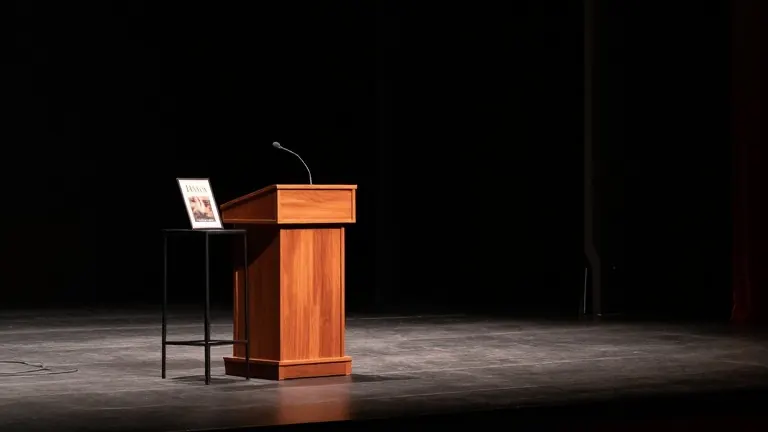
Abdelrahman ElGendy won the National Book Award for non-fiction for his memoir 'Huna', but he was not present to receive the trophy in New York City. The award ceremony took place on November 18, 2026. ElGendy, an Egyptian political prisoner, could not attend because his U.S. visa from Europe was denied.
The book details six years ElGendy spent in captivity. He published an essay in The New Yorker the previous week explaining his absence. The piece raised questions about his eligibility for the award. The National Book Foundation issued a statement hours before the ceremony. The organization said it expanded eligibility criteria in 2024. The foundation stated it was proud to celebrate 'Huna'.
Helen Thomaides, ElGendy's editor, accepted the award on his behalf. She read a statement written by the author. ElGendy wrote that he used to fantasize about writing a memoir in his prison cell in Egypt. He noted that the dream should have come full circle that day. Instead, he said the circle remained unfinished. He attributed the break to an oppressive regime with a fascist ideology.
Hannah Lilith Assadi won the Fiction award for her novel 'Paradiso 17'. The story follows Sufien, a Palestinian man exiled from his home in 1948. Assadi spoke about the book's origins at her father's deathbed. She described watching cancer ravage his body and genocide ravage his people. She called the Palestinian story beautiful and painful, saying it is the story of all of us.
Brenda Hillman won the Poetry award for 'Still House in the Desert: An eco-contemplation'. The book meditates on returning to her childhood home after her mother's death. Hillman thanked writers who had previously composed poetry. She advocated for poetry's place in everyday life and in year-end best books lists.
Vicente Luis Mora and translator Rahul Bery won for Translated Literature. Their book, 'Centroeuropa', is a stylistically experimental novel. It centers on a 19th-century man attempting to bury his dead wife. While digging, he finds soldiers from various eras and wars. David Levithan and Gabriel Duckels won the Young People's Literature award for 'The Fight of Our Lives: AIDS in America'. The book is a history of HIV and AIDS and the grassroots response to the crisis.
The National Book Foundation also awarded two lifetime achievement prizes. Pediatrician and literacy advocate Perri Klass received one. She accepted the award while holding a stethoscope and a copy of 'Goodnight Moon'. Author Salman Rushdie received the other lifetime achievement honor. In his speech, Rushie paid respects to Ursula K. LeGuin. He said LeGuin was almost the only person who liked his first novel, published 51 years ago. He stated that her support meant everything to him.
Actor Kyle MacLachlan hosted the event. He opened the proceedings by talking about his lifelong love of books. He included jokes about artificial intelligence and admitted to not reading all the nominated books.
More Culture · Albuquerque news · Report a business · Got a Story?