Garment workers in Savar block highway in wage dispute
Police used tear gas and batons against thousands of protesters in Dhaka suburbs as factories closed across three districts.
By Connor Murphy ·
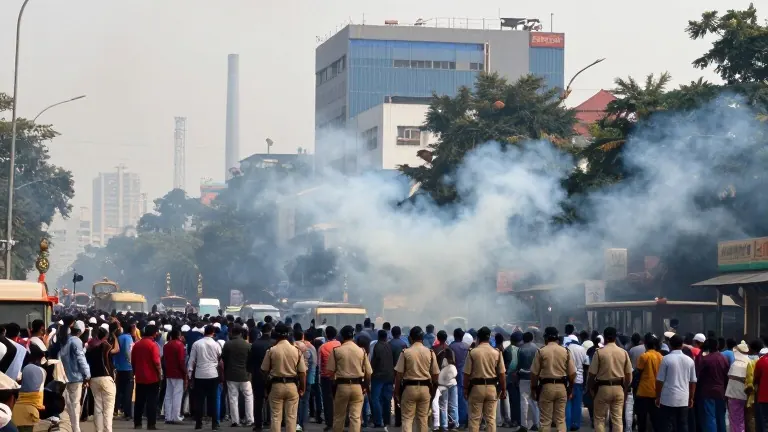
More than 20,000 garment workers blocked the Dhaka-Aricha Highway in Savar on Wednesday, triggering a violent confrontation with police that left the main export artery to the capital impassable. The clash occurred outside Dhaka, the nation’s capital, where local media reported the largest single-site protest of the ongoing wage dispute.
Police responded to the blockade by charging the crowd with batons and deploying tear gas and stun grenades to disperse the workers. Local police chief Saiful Alam stated that officers acted after protesters blocked the highway and threw stones at them. It was not immediately clear how many people were injured in the encounter.
The unrest extended beyond Savar to the nearby area of Ashulia, which the Daily Star newspaper identified as a center of the conflict. Police reported that approximately 25 factories in Ashulia closed due to the disruption. Further south, in the Gazipur district, protesters blocked the Dhaka-Mymensingh highway and set fire to a police vehicle. Police again used tear gas and stun grenades to manage the crowd in that industrial zone.
The demonstrations have become routine in recent weeks as the industry faces weeks of production chaos. Workers are demanding a minimum monthly wage of 30,000 takas, equivalent to $236, up from the current rate of 12,500 takas, or $98. Protesters argue that inflation and rising living costs have eroded their purchasing power, a key driver of the sustained strikes.
The garment sector is the backbone of Bangladesh’s export economy, generating approximately $40 billion annually through roughly 2,500 factories. About 4 million workers, most of them women from rural areas, are employed directly in the industry. An additional few million work in the backward linkage sectors that support the main factories.
Many factories have remained shut under a “no work, no pay” provision in labor laws, which allows owners to suspend operations during periods of unrest. The government has established a board to determine a new wage package, but the measure has not satisfied the protesters. The Bangladesh Garment Manufacturers and Exporters Association and the Bangladesh Knitwear Manufacturers and Exporters Association have demanded police protection for their facilities.
The wage dispute continues to disrupt production across the country, with closures and street clashes becoming a regular feature of the work week in the Dhaka metropolitan area.
More Business · Albuquerque news · Watch Your Wallet · Report a business · Got a Story?