Palestinian Artists Confront History Through Anger and Defiance
A new exhibition at a former military hospital in London presents works by Palestinian artists that weave personal exile with national trauma, challenging viewers to confront the enduring legacy of displacement.
By News Media House Staff ·
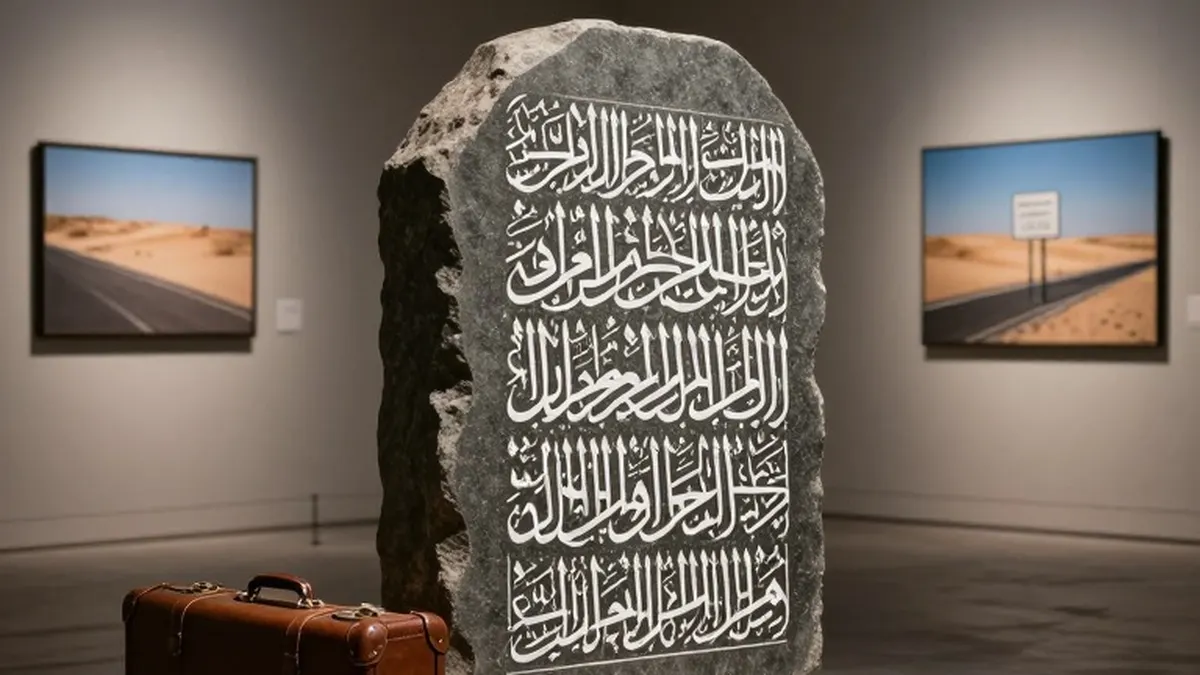
A new exhibition currently on view in London invites viewers to engage with the history of Palestine through the lens of its artists, blending documentation of historical atrocities with expressions of both cold and hot anger. The show, titled after a line from a poem by Mahmoud Darwish, opens with a work by Simone Fattal. In 2006, Fattal painted the names of locations associated with massacres in the Levant since 1948, including Deir Yassin, Jenin, Qana, and Sabra, onto basalt slabs. Running through these names in Arabic script is a line of poetry by Etel Adnan that describes rain in these lands as being made of bullets. This piece sets the tone for a display that combines the recording of history with a deep sense of defiance.
The exhibition draws a clear connection between personal displacement and the broader cosmopolitan culture of the Levant. Darwish, who wrote in exile in Beirut, used the sea as a symbol for Palestinian memory and displacement. His work, along with that of other artists in the show, links people scattered across the eastern Mediterranean to their homeland. A central theme emerging from these pieces is that living in exile is often an act of waiting. This sentiment is physically represented by a suitcase carried out of Gaza by Hazem Harb in 2006, which sits on the floor beside Fattal’s monument. Above the suitcase, framed photocollages reference an international airport that was bulldozed by the Israeli Defense Forces four years earlier, raising questions about the possibility of return.
The sense of powerlessness and apprehension is further explored through photography and self-portraiture. Rula Halawani’s photographs of people at Palestinian checkpoints capture this mood in the faces of those waiting. Tarek Al-Ghoussein, who died in 2022, never set foot in his own country. Born in Kuwait to Palestinian parents, he explored his fragmented identity through a series of photographs displayed on glowing lightboxes. His self-portraits combine unsettling symbols, such as a black-and-white keffiyeh, with settings like airport runways and abattoirs. One image shows the artist looking out to sea, evoking a sense of indignation at his separation from his native landscape rather than awe at its grandeur.
For those who cannot see their homeland, the act of inventing it becomes a form of storytelling. Basma Al-Sharif, also born in the Gulf to Palestinian émigrés, attempted to tell a conventional love story set in the Levant. However, she became entangled in the networks of nationalism and identity that govern such narratives. Her work, which includes video, photographs, and botanical drawings of native and invasive species, serves as a witness to the impossibility of separating individual stories from their political and social conditions. This highlights the privilege required to create art for its own sake, a luxury made possible by injustices that are often out of sight.
The exhibition also challenges the cliché of Palestine as the land of milk and honey. Khalil Rabah’s sardonic paintings of road signs pointing to bodies of water in parched landscapes suggest that the destruction of the natural environment is a long-standing strategy of occupation. This idea echoes the phrase attributed to the Roman historian Tacitus, who noted that invaders make a land a desert and call it peace. Recurring images of rain, drought, water, and sea throughout the show, including in a neighboring exhibition of paintings by the Gazan art collective Eltiqa, function as more than just poetic metaphors. They serve as tangible reminders of the physical and environmental realities faced by Palestinians.
The show is presented from Palestinian perspectives using works from the collection of a UAE-based foundation with a longstanding commitment to the cause. However, it includes three rooms dedicated to the work of Abdul Hay Mosallam Zarara, which some may view as agitprop. His painted reliefs depict Palestinian heroes battling imperialist forces. While this style can be considered propaganda, similar to the anti-Nazi photocollages of John Heartfield, it effectively connects the Palestinian story to other anti-imperialist struggles, from Chile under Pinochet to apartheid-era South Africa. A notable painting commemorates the hunger strikers who died in the Maze in 1981, affirming a link between Irish republicanism and Palestinian independence that informs the exhibition’s presence in a state-funded institution.
The exhibition serves as a timely spotlight on Palestinian artists, fulfilling a function described by the critic John Berger, who was born 100 years ago this month. According to this view, art serves as a meeting place for the invisible, the irreducible, and the enduring. By showing the future what the past has suffered, these artists remind viewers that art can never be entirely separated from the political, economic, and migratory systems that produce the societies in which we live. Until a collective utopia is achieved, such exhibitions remain essential in bridging the gap between historical trauma and contemporary understanding.
Originally published by News Media House