Public Defender Calls for Virtual Hearings as ICE Uses Court Records to Arrest Immigrants in Santa Fe
District Defender Julie Ball says federal agents are leveraging public court documents and informal cooperation to apprehend defendants, prompting a push for new state legislation.
By Connor Murphy ·
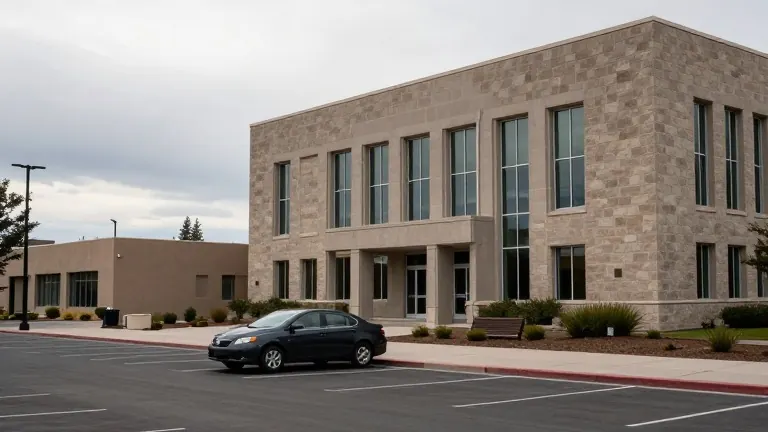
Julie Ball, the district defender for New Mexico’s First Judicial District, says her office is moving toward more virtual hearings for clients to shield them from federal immigration agents waiting outside courthouses. Ball oversees legal representation for indigent defendants in Santa Fe, Rio Arriba, and Los Alamos counties. She said the activity by U.S. Immigration and Customs Enforcement around courthouses has increased. “If this upswing continues, then we … will be instituting more motions for our clients to appear virtually,” Ball said. She noted that this issue affects all immigrants, including those who are in the United States legally.
Ball described a recent incident where ICE agents detained a client using a tactic she called a ruse. The man was on pretrial release with an ankle monitor. He received a call from someone claiming to be from the electronic monitoring company, who told him the device had lost connection and instructed him to exit his home. Agents were waiting outside. Ball said the Santa Fe Immigration Committee helped secure his release. “It was just overwhelming, the assistance that the community poured out for this person,” she said.
Barry Massey, a spokesperson for the Administrative Office of the Courts, said the judiciary found no indication that court staff were involved in that specific arrest. He wrote that court documents are public records, including orders requiring defendants to wear GPS tracking devices. This suggests ICE uses public information to track defendants without formal help from court employees.
Santa Fe County Magistrate Judge David Segura said he has not been made aware of ICE agents targeting immigrants through local courts. “There has been none of that activity that we have been made aware of, no law enforcement doing that whatsoever,” Segura said. The First Judicial District Attorney’s Office also denied knowledge of an ICE presence in state district courts, though a spokesperson, Catherine Lynch, acknowledged the potential complications.
Lynch stated that ICE involvement around courthouses can discourage participation by victims, witnesses, and defendants. “Our concern remains ensuring that everyone can participate in the judicial process without fear or intimidation,” Lynch said. Ball argued that many arrests violate due process by interceding in the criminal justice system. “We’re criminalizing the state of being an immigrant, and using deportation as a punishment without due process of law,” she said.
In August, immigration agents arrested a father with legal status in the parking lot of a medical clinic in Torrance County. He spent 23 days in the Torrance County Detention Facility in Estancia before being released. A deportation officer later admitted in a court filing that agents had mistaken him for someone else. The agency had labeled him a “criminal illegal alien.”
Teague González, executive director of the New Mexico Immigrant Law Center, told state lawmakers earlier this month about a person with a traffic citation who exited a Carlsbad courthouse only to be arrested by ICE. “And ICE just happened to know the moment that he was walking out,” González said. He and other attorneys presented a slate of cases to the interim legislative Courts, Corrections and Justice Committee. They argued that a gap in state law permits local agencies to informally collaborate with ICE, even though formal cooperation is barred.
González cited an alleged practice by Sandoval County sheriff’s deputies of turning over immigrants to ICE agents in a store parking lot. “No law prohibits that right now from happening,” he said. State Ethics Commission filed a lawsuit against the New Mexico Corrections Department in September 2025 over allegations that probation and parole employees in Santa Fe and Albuquerque worked with federal agents to lure immigrants to arrests. Corrections Secretary Alisha Tafoya Lucero told a legislative committee last month that her agency is moving toward a settlement.
Albuquerque Democratic Sen. Antoinette Sedillo Lopez and Rep. Cristina Pajarón indicated they would sponsor a bill to extend the 2025 prohibition on state employees sharing information with federal agencies to local employees. Ball said she supports the legislation to close these loopholes. “The legislative session is a full session this year,” Ball said, referring to the 60-day session starting in January. She added that the Santa Fe Immigration Committee will lobby the Legislature.
More Politics · Albuquerque news · Report a business · Got a Story?