Loving residents demand air monitoring after Permian oil surge
Local engineer Jackie Onsurez calls for stricter enforcement and new data collection in the Delaware Basin.
By Connor Murphy ·
Jackie Onsurez returned to Loving in 2020 to care for his aging father and found a town changed by rapid oil development.
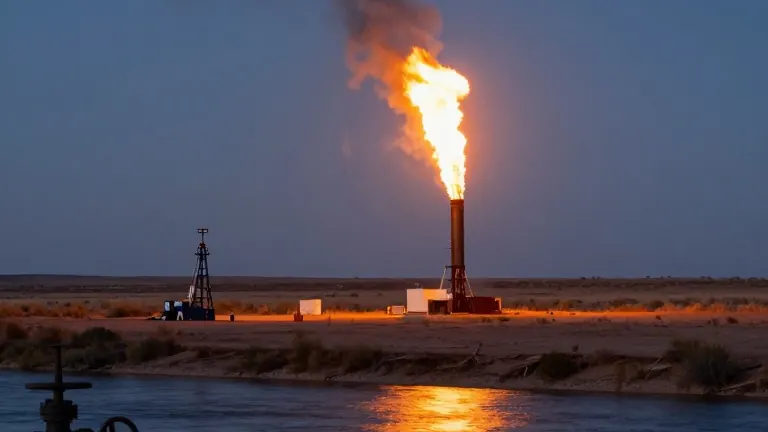
Onsurez, an electrical engineer who spent a decade building infrastructure in Saudi Arabia, now works at the Waste Isolation Pilot Plant nearby. He described the environment shifting around him, noting that drilling occurred near the local school. He called state agencies about the noise from a nearby flare, but officials told him the loud noise was a nuisance issue outside their jurisdiction.
Oil production in New Mexico has increased sharply over the last decade. Output rose from just over 12 million barrels in July 2016 to more than 75 million barrels in July 2025. Loving sits at the center of the Delaware Basin, the most productive oil and gas field within the larger Permian Basin.
Onsurez noted that air quality data for Loving was difficult to locate, unlike the records he managed in Saudi Arabia. He asked state agencies why they were not monitoring expected pollutants. The New Mexico Environment Department began monitoring BTEX compounds, which signal leaks from oil operations, only in late 2023. Loving is not yet included in that monitoring network.
Federal regulators also retreated from strict oversight. The Environmental Protection Agency backed off a proposal to designate the Permian Basin for protection under the Clean Air Act in 2023 after pressure from Texas. New Mexico has not pursued the case further.
Diane Denish, the state’s lieutenant governor from 2003 to 2011, grew up in Hobbs, a nearby oil town. She recalled that water scarcity was not a common concern during her childhood. "Nobody ever worried about water when I was growing up," Denish said. She described a time when swimming pools were common because residents could afford them, and the smell of petroleum was accepted as the scent of money.
Flares were a familiar sight in Hobbs, even appearing in the local high school fight song. Companies use flares to burn off unwanted natural gas. Operators reported flaring 36,464 times in New Mexico in 2025. That volume of gas could power approximately 7.7 million homes for a year and had a market value of about $33 million. Flaring produces carbon dioxide, carbon monoxide, nitrogen oxides, sulfur dioxide, and black soot.
A 2016 study linked air pollution from U.S. oil and gas flares to 410,000 asthma exacerbations, 2,200 new cases of childhood asthma, and 7,500 excess deaths. Onsurez said residents in Loving have reported respiratory incidents at schools and visible pollution in the air. He pointed out that more than 380 oil, gas, and injection wells in the Permian Basin lie within a half mile of the Pecos River.
Onsurez ran for the Democratic nomination for lieutenant governor but did not gather enough signatures for the primary ballot. He said he met with Environment Department employees who indicated that a new air monitoring station is planned. Secretary James Kenney told Onsurez that a mobile air monitoring lab should be operational by the end of 2025. This follows a 2022 settlement where OXY USA paid $500,000 to WildEarth Guardians for air quality projects, funds the state received in 2024.
Recent studies have identified airborne radiation plumes and ozone levels exceeding federal limits in Loving. Onsurez said he understands now what the changes mean for public health. "We need air monitoring here in Loving," he said. "We need more people regulating the oil and gas industry."
More News · Albuquerque news · Report a business · Got a Story?