Tulsa neon signs return to Route 66
Historic signs restored and new installations are lighting up the old highway as the city marks the road's centennial.
By Scott Marshall ·
More than 100 neon signs now illuminate Tulsa, a number that reflects a recent surge in restoration and new installations along the historic Route 66 corridor. The city is using these glowing markers to reinvigorate interest in the roadway as it approaches its 100th anniversary.
The Tulsa Route 66 Commission launched a grant program in 2019 to fund new neon or LED signs and to restore vintage pieces. This initiative followed a period of decline when five interstate highways replaced sections of the original road, causing it to lose federal highway status in 1985. As traffic shifted to the interstates, many roadside businesses closed, and their expensive neon signage was often turned off or dismantled.
One of the most prominent survivors is the Meadow Gold sign, a massive landmark advertising a local dairy. The sign features letters up to seven feet high and is roughly the size of a school bus. Originally built by Claude Neon Federal Signs in 1934, the structure sat in storage for decades before being saved from demolition in 2004.
Workers at Claude Neon Federal Signs rebuilt the scaffolding and restored the porcelain letters for the Meadow Gold sign. The company, which is based in Tulsa, has been operating for 100 years. It was founded with a franchise from Georges Claude, the Parisian inventor who developed neon lighting technology in 1910. The sign was relit and placed in the Meadow Gold section of town in 2009.
Crafting these signs remains a manual process. Tom Wolski, a neon bender at Claude Neon Federal Signs, heats glass tubes in fire and bends them by hand to form shapes. He notes that the work involves extreme electricity, fire, phosphorus, and mercury. Wolski told visitors to stand back from the studio equipment, describing the environment as dangerous but something he loves.
The company is one of the few that still employs full-time neon benders. Senior designer Joe Kesterson explained that the cost of traditional neon has driven many clients toward LEDs, which are cheaper to produce and operate. However, Kesterson argues that LEDs lack the soft, candle-like glow of true neon. He said that when viewed together, the LED light appears harsh by comparison.
Kesterson also clarified the chemistry behind the colors. Neon gas creates a red illumination, while cool colors are produced using argon gas and mercury. A phosphor powder coating on the inside of the tubes interacts with these gases to create a wide range of hues. He noted that the mixing process often results in unexpected colors, defying simple color theory.
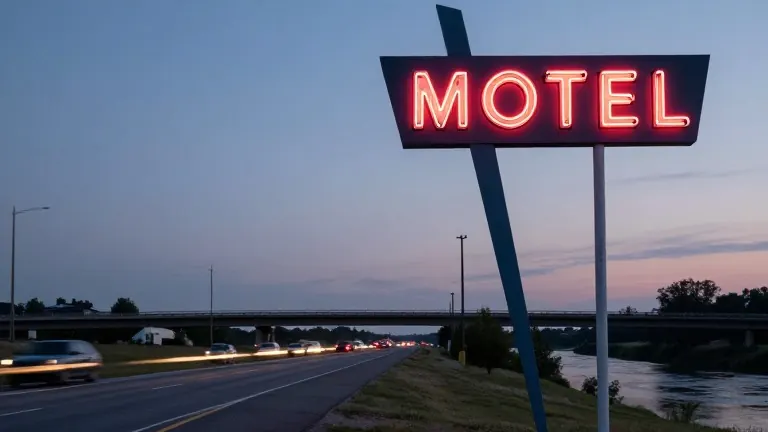
The new installations include re-created vintage signs in Neon Sign Park, which is part of Cyrus Avery Plaza. The park is located on a quiet section of Route 66 next to a river and train tracks, below Interstate 244. Among the replicas is a sign for the Will Rogers Motor Court, featuring a cowboy on a horse circled by a gold lasso. Another replica depicts the Tulsa Auto Court with a red car and a driver silhouette. Kathleen Franz, a specialist in technology history at the National Museum of American History, said that neon signs historically signaled to travelers that a business was modern, clean, and safe.
More News · Albuquerque news · Report a business · Got a Story?