UNM Professor Wins Grant to Continue Water Restoration Work in Borrego Pass
Anthony Fettes’ design studio will use Envision Resilience funds to expand hands-on watershed projects at the Hózhó Voices of Healing Center through 2027.
By Scott Marshall ·
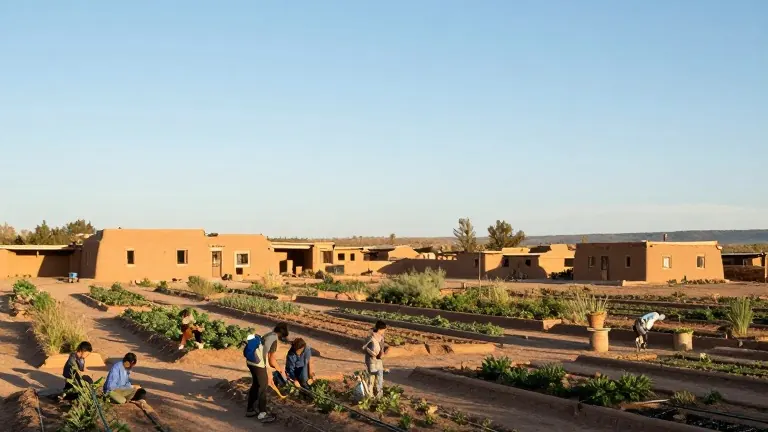
Anthony Fettes, an associate professor at the University of New Mexico School of Architecture + Planning, has received a National Design Studio Grant. The award provides funding for his graduate design studio, Designing for Hózhó: Healing Land, Water, and Well-being. The grant supports the studio’s ongoing work at the Hózhó Voices of Healing Center in Borrego Pass, New Mexico.
The National Design Studio Grant program backs design studios that explore adaptive solutions to climate change in rural, urban, and mid-sized communities. The program aims to advance planning and design through partnerships between students and local residents. For the 2026 academic year, the studio will return to the center located at Dibe Yazhi Habitiin.
In 2024, the initial studio phase focused on establishing cultural grounding, understanding the site, and developing a design vision. The 2026 work moves into hands-on implementation. Students are engaged in watershed restoration and water-harvesting tasks. These efforts address specific climate vulnerabilities facing Navajo, or Diné, communities.
The studio’s design process relies on the Diné concept of Hózhó, which emphasizes balance, harmony, and beauty. It also stresses maintaining a positive relationship with the land. The team is designing demonstration projects that use passive water harvesting and land restoration techniques. These methods draw on Local and Traditional Ecological Knowledge, or lo-TEK. The goal is to support future orchards, gardens, and wildlife habitat while protecting existing historic structures.
Fettes said the grant allows the studio to expand its scope and continue its partnership with the Hózhó Center and surrounding communities. He noted that the work aligns with regional ecological restoration organizations. The project centers on traditional and hybrid land management practices. Fettes said the team exchanges ideas with Indigenous community partners to deepen their connection to the place.
Catherine Page Harris, the Landscape Architecture Department chair, said the department is grateful for Envision Resilience’s recognition of the faculty and student work. She stated that the project weaves Indigenous knowledge with contemporary practice to address climate change in New Mexico. Harris encouraged students to dream big in response to current challenges.
Beyond service learning, the studio is documenting the process from cultural learning through construction. The team is creating an illustrated, community-accessible guide to arid land watershed restoration. The guide is designed to help others in the region replicate these strategies with minimal resources. In late 2026 and early 2027, the team plans to expand the guide into on-site workshops for surrounding communities.
Traditional Ecological Knowledge forms the foundation for all design decisions. This knowledge is integrated with contemporary grading, drainage, and green infrastructure techniques. Regional experts help develop these technical aspects. Students work in small teams, with each team responsible for a distinct site project.
The studio partners with a growing number of organizations, including Rio Grande Return. This local non-profit uses low-tech, process-based methods to restore ecosystems in the Southwest. The Indigenous Landscape Studio partners with nine Diné and Pueblo communities and nonprofits. It is supported by the Indigenous Design and Planning Institute at UNM. All projects are driven by community-identified needs and aspirations.
The long-term goal is to advance the center’s vision for regenerative land management, food sovereignty, and wellness. The studio also aims to develop a replicable model for climate-adaptive design in rural Indigenous and arid communities across the American Southwest.
More News · Albuquerque news · Report a business · Got a Story?