Voyager 1 reaches distance of one light day from Earth
The 1977 spacecraft will mark 49 years of travel on Wednesday as NASA invites the public to blink its call sign in Morse code.
By Connor Murphy ·
Voyager 1, a spacecraft launched by NASA, will become the first human-made object to reach a distance of one light day from Earth. The milestone is scheduled for 5:16 a.m. ET on Wednesday. This mark represents the distance light travels in 24 hours, a span of more than 16 billion miles.
The probe launched on Sept. 5, 1977. For nearly five decades, it has traveled through the outer solar system. Its journey included close flybys of Jupiter and Saturn. In 1979, it identified a faint ring system around Jupiter. The following year, it captured detailed images of Saturn’s rings and moons.
Voyager 1 overtook the Pioneer 10 space probe on Feb. 17, 1998. That event made Voyager 1 the most distant human-made object in existence. It and its twin, Voyager 2, are the only spacecraft to operate outside the heliosphere, a protective shield surrounding the solar system. Voyager 1 crossed into interstellar space in 2012.
The spacecraft continues its mission by measuring magnetic fields, particles, and plasma waves outside the sun’s influence. Two science instruments remain active. One measures magnetic fields, while the other detects plasma waves. Earlier this year, NASA turned off the Low-energy Charged Particles experiment to conserve power. This change is expected to extend the probe's operational life.
The spacecraft also carries the Golden Record, a gold-plated disk intended as a message to extraterrestrial life. The record holds 115 images and natural sounds, including surf, wind, and animal noises. It contains spoken greetings in 35 languages. The disk includes symbolic instructions for playing the record and indicates the probe’s origin.
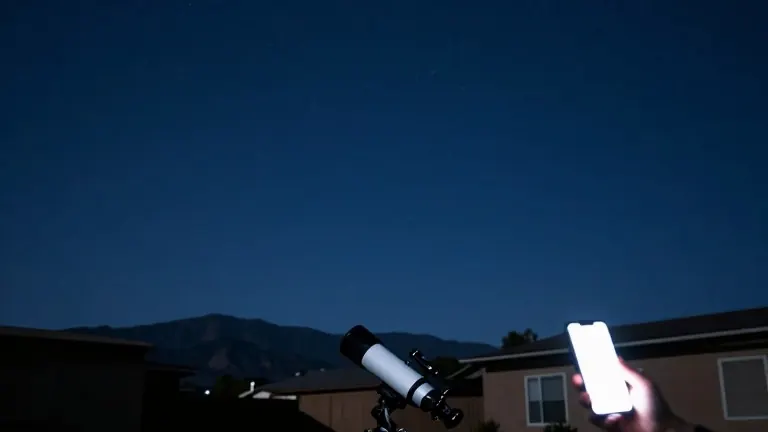
NASA is observing the milestone with an event called Shine Bright for Voyager’s Light-Day. On Tuesday night, the agency asked the public to transmit the spacecraft’s call sign, V-G-R, using light. Participants can use flashlights, phone screens, or other blinking devices. The Morse code sequence for the call sign is three quick flashes followed by one long flash for V, two long flashes followed by one quick flash for G, and one quick flash, one long flash, and one quick flash for R.
More Tech · Albuquerque news · Report a business · Got a Story?