Voyager 1 Reaches One Light-Day Distance From Earth
The 49-year-old spacecraft will mark a new interstellar distance record on Wednesday, sending signals that take 24 hours to arrive at Earth.
By Paula Delgado ·
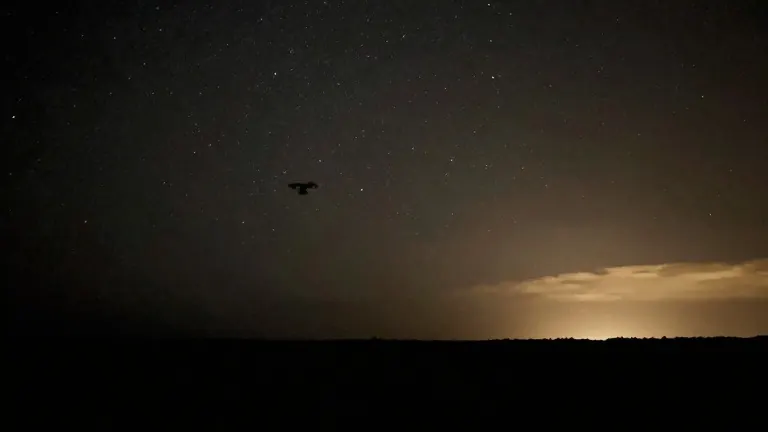
NASA's Voyager 1 will cross a new distance threshold on Wednesday as it travels one light-day away from Earth. This milestone marks the farthest point any human-made object has traveled. The spacecraft will have moved more than 16 billion miles from its launch site.
At this distance, radio signals from the probe will take exactly 24 hours to reach Earth. The craft is moving through interstellar space at a speed of 38,000 miles per hour. Scientists estimate it will take another 18,000 years for Voyager 1 to reach a distance of one light-year from Earth.
Suzanne Dodd, the project manager, described the spacecraft as a national treasure. She told the Associated Press that the mission provides a sense of wonder for people on Earth. Dodd has worked with the Voyager missions since 1984. She compares the data stream to weather satellite reports, noting the craft sends information about magnetic fields, pressure, and dust almost daily.
The spacecraft was launched 49 years ago in 1977. It flew past Jupiter in 1979 and Saturn in 1980. NASA confirmed the probe exited the solar system in 2012. Its twin, Voyager 2, will not reach the one light-day mark until 2035. Both spacecraft continue to send engineering and science data despite their age.
The flight control team at NASA's Jet Propulsion Laboratory in Pasadena, California, sends commands to the probe about once a week. The team expanded its efforts in September to conserve power for the plutonium-driven system. In October, controllers briefly lost contact with Voyager 1. They are still investigating the cause of that communication disruption.
In 1990, Voyager 1 took the famous "Pale Blue Dot" image of Earth from beyond Neptune. Astronomer Carl Sagan, who was part of the imaging team, introduced the photo to the public that year. He described Earth as a small stage in a cosmic arena. The Planetary Society co-founded in 1980 by Sagan has highlighted the mission's impact on people alive today.
Each Voyager carries a 12-inch gold-plated record. The disc contains greetings in 55 languages, images, and diagrams. Sagan included a voice recording of his son Nick, who was six years old at the time. The recording says, "Hello from the children on Planet Earth." Dodd calls the record a time capsule of life on Earth from 1977.
NASA has encouraged the public to celebrate the milestone after sunset on Tuesday. People are asked to use phones or flashlights to create a wave of golden light. The light will be used to spell the letters V-G-R, which is Voyager's call sign, using Morse code.
More News · Albuquerque news · Report a business · Got a Story?