25 years since New Mexico’s final lethal injection
Terry Clark’s execution in 2001 marked the last state-killing before lawmakers abolished the practice in 2009.
By Connor Murphy ·
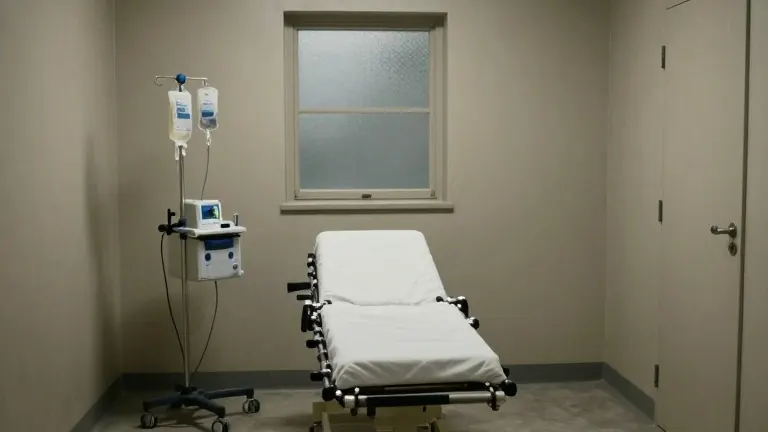
Twenty-five years ago, New Mexico carried out its final execution. On the evening of Nov. 6, 2001, prison officials injected the lethal drugs that killed Terry Clark at the Penitentiary of New Mexico outside Santa Fe. Clark, 45, had been sentenced to death for the 1986 killing of 9-year-old Dena Lynn Gore. Gary Mitchell, who represented Clark in appeals, was in a hotel room in Carlsbad when he received a call from a juror who had voted for the death penalty.
Clark’s case began in July 1986 when Gore left her home in Artesia on her brother’s bicycle to visit a convenience store. Her body was found five days later in a shallow grave on a ranch 60 miles away where Clark worked. Clark had pleaded guilty to the killing. At the time, he was out on bond while appealing a separate conviction for kidnapping and raping another young girl. A jury in Tucumcari first sentenced him to death, a decision the New Mexico Supreme Court overturned. A second jury in Silver City later returned the same verdict.
Mitchell said Clark eventually told a judge he wanted to drop a pending appeal and proceed with the execution. Mitchell attributed this decision to Clark’s minister, who supported capital punishment. Mitchell argued in court that Clark was not competent to waive his appeal, but a state district judge set a date for the execution. Twelve people, including Colleen Romero, Dena Lynn’s mother, watched the execution from a witness room in the penitentiary’s death house.
Romero described the execution as providing her with a lot of closure. “I haven't changed my mind on any of it,” she said in an interview Thursday. “I never regretted it, and it was the very last thing I could do for my daughter.” She noted that Clark had a prior conviction for child rape, arguing that life in prison was not a sufficient punishment for a child molester and murderer.
Public opinion in New Mexico was mixed around the time of the execution. Two groups gathered outside the prison: those in support of the execution, including the victim’s family, and those protesting the death penalty. After Clark’s death, the practice fell out of favor with lawmakers and the public. In 2009, Gov. Bill Richardson signed a bill abolishing the death penalty. The state then had only a few men on death row, whose sentences were commuted to life in prison without the possibility of release or parole.
Allen Sánchez, executive director of the New Mexico Conference of Catholic Bishops, stood beside Richardson during the signing. Sánchez credited the Catholic Church’s years of advocacy for the change. Richardson had previously opposed abolition, partly due to his presidential ambitions and concerns about appearing soft on crime. Sánchez told Richardson that the governor should understand the death penalty better than anyone, given his own federal investigation. Richardson agreed to the bill shortly after. Mitchell cited the high cost of death penalty cases and disparities in how they were applied as key factors in the state’s decision to end the practice.
More News · Albuquerque news · Report a business · Got a Story?