Gulf Nations Brace for U.S. Iran Strikes
Qatar mediators work to prevent new attacks as regional leaders assess economic and military risks.
By Scott Marshall ·
Residents across the Gulf region face heightened uncertainty as the United States and Israel plan for potential strikes on Iran following the U.S. midterm elections on Tuesday. Qatar has led intensive mediation efforts over the past 72 hours to prevent immediate military action, but no final agreement has been reached.
The first key development involves diplomatic movements between Doha and Tehran. Iranian mediators visited Tehran, while an Iranian delegation traveled to Doha during this three-day period. Abbas Araghchi, Iran’s foreign minister, stated in Iranian state media on Sunday that definitive conclusions remain elusive. However, he described a proposed two-day plan wherein Iran would cease attacks on ships in the Strait of Hormuz to allow direct talks between Washington and Tehran to resume.
President Donald Trump addressed the likelihood of renewed conflict at a Halloween party at Mar-a-Lago. He stated that the U.S. is not in a hurry and claimed that U.S. forces have destroyed nearly all major Iranian military equipment and manufacturing capabilities. Trump noted that only one or two nuclear sites remain, which he said could be eliminated in ten minutes. Despite his remarks, senior European diplomats and Arab military generals in the Gulf report that they do not know what Trump will decide after the elections.
The second key point concerns the enduring military capability of Iran despite eight months of war. The conflict began in February, resulting in the deaths of Iran’s supreme leader and top military commanders, as well as the destruction of many ships and missile production sites. Although Israel stated that toppling the regime was a goal, the government remains in place. The Iranian Revolutionary Guard retains the ability to inflict damage on Gulf Arab countries, which are major global producers of oil and gas. Brent crude oil prices have risen 60 percent since the war began, driven in part by Iran’s closure of the Strait of Hormuz.
The third key development is the strategic posture of Iran’s new leadership. Mojtaba Khamenei, Iran’s supreme leader, instructed armed forces commanders this weekend that any threat must be met with an immediate response without geographical limitations. Iranian state media interpreted this to mean that new U.S. or Israeli attacks would cause greater damage than previous rounds of fighting. This message aims to deter further strikes by emphasizing the scale of potential retaliation.
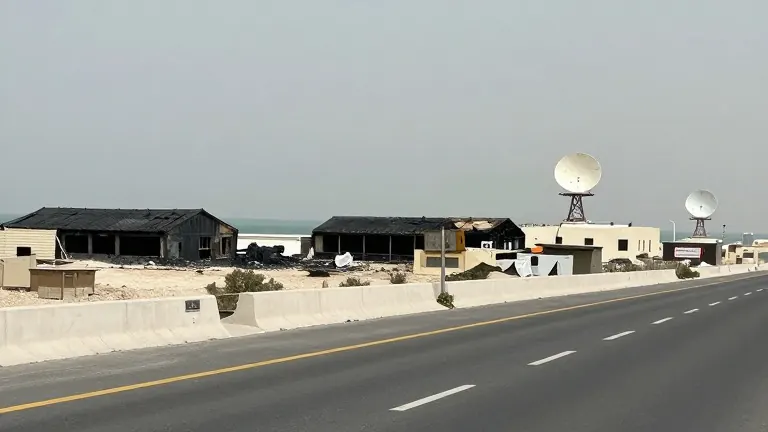
In Bahrain, the physical impact of the war is visible. The country, home to the U.S. Navy’s Fifth Fleet, suffered strikes on logistics hubs and warehouses on the first day of the war on February 28. Radar equipment and charred storage facilities remain visible from nearby highways. The base previously housed 8,000 military personnel but now holds fewer than 100. Bahrain’s Foreign Minister Abdullatif Al Zayani spoke at the Manama Dialogue security forum about missiles and drones fired at both military sites and civilian infrastructure. He noted that the Iranian Revolutionary Guard has threatened to hit undersea internet cables in the Strait of Hormuz if the war resumes, a tactic already used against Amazon data centers in the United Arab Emirates and Bahrain.
Gulf Arab states view Iran as a primary security threat but also as a close neighbor. While they support U.S. pressure on Tehran, they generally prefer to avoid direct warfare. Anwar Gargash, a senior Emirati diplomat, stated at the summit that the region must use political tools as its main instrument. He argued that military solutions would complicate the current situation and would not provide a quick path to a solution. The unified message from Gulf leaders is that additional attacks on Iran would be devastating to their economies and infrastructure.
More World · Albuquerque news · Report a business · Got a Story?